+86-18394093613 


Choosing the best Mdf Cake Board supplier in China requires more than comparing catalog prices. A reliable supplier should control material density, surface smoothness, moisture resistance, and edge finishing. These details affect how safely and neatly a cake reaches the customer.
Daniel Chen, a packaging engineer with twelve years of bakery-packaging experience, says, “A dependable Cake Board Mdf supplier proves consistency before discussing volume.” His point deserves attention. A beautiful sample may not represent every production batch. That is where many buyers become disappointed.
This guide examines suppliers through practical evidence. We will consider factory experience, board thickness, load testing, printing quality, and protective packaging. We will also look at food-contact materials and documented quality procedures. These checks help buyers reduce breakage, warping, and uneven printing.
A strong supplier should provide clear samples, production photos, inspection records, and realistic lead times. Communication matters too. Fast replies are useful, but accurate replies matter more. Ask whether the MDF core changes between batches. Ask how the supplier protects boards during humid shipping. Small questions reveal larger habits.
Some suppliers may offer excellent prices but weak after-sales support. Others may have impressive equipment but limited customization. Neither option is automatically best. The right choice depends on cake size, design, order volume, and target market.
There is no perfect supplier.
Therefore, this comparison keeps room for doubt. Testing remains essential. A careful buyer should verify each claim before signing a long-term agreement. This approach makes the search for China’s best Mdf Cake Board supplier more practical, transparent, and dependable.
Mdf Cake Boards: Materials, Structure, and Common Uses
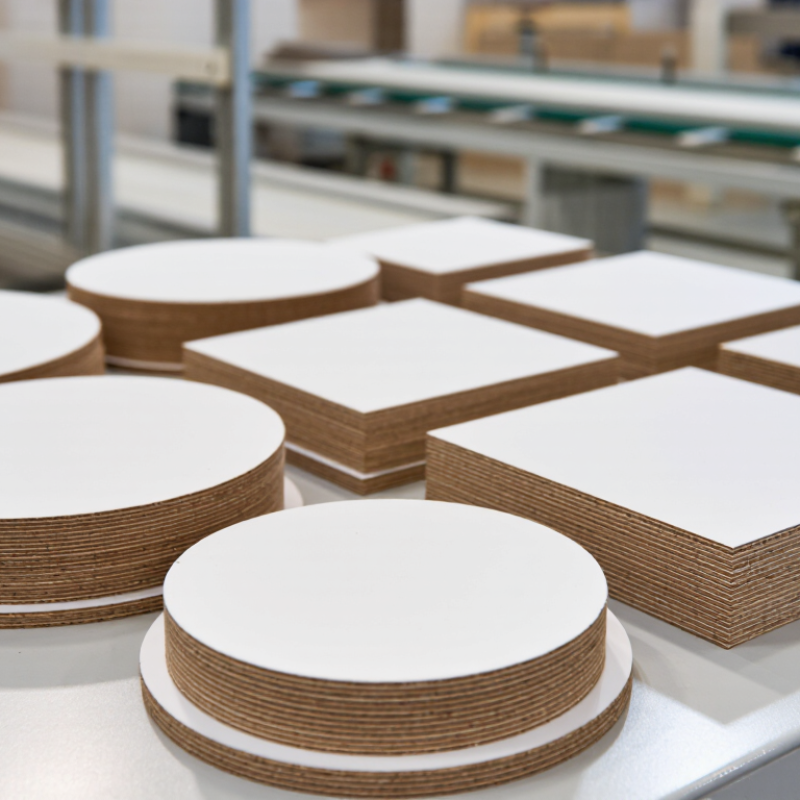
An Mdf Cake Board is made from compressed wood fibers, resin, and controlled heat. Its dense core provides a firm surface for sponge cakes, fondant cakes, and layered desserts. Unlike corrugated cardboard, MDF usually bends less under moderate weight. However, moisture remains its weakness. Cream, syrup, and refrigeration can affect an unsealed edge.
The board commonly has a smooth face, a compact center, and a sealed or coated surface. Thickness should match the cake’s weight and diameter. A small dessert may need only a thin board, while a tall wedding cake requires stronger support and careful handling. Experienced buyers should ask suppliers in China about fiber density, thickness tolerance, edge finishing, and packaging protection. Clear inspection records build more confidence than attractive product photos. I would not judge quality from appearance alone. A board can look polished and still absorb moisture quickly.
Tips: Keep the cake board covered before use. Check for warping, rough edges, and odor after opening the carton. Choose a food-safe covering layer when the board may touch exposed cake. Store boards flat in a dry room. Small details matter. Supplier communication also deserves attention; vague answers about materials or testing should encourage a second review.
Mdf Cake Boards are made from compressed wood fibers bonded into a dense, smooth panel. Thinner boards are commonly used for lightweight cakes and separators, while thicker boards provide greater rigidity for layered, fondant-covered, and larger celebration cakes. The values shown are representative thickness specifications commonly used for these applications.
Choosing the best Mdf Cake Board supplier in China requires more than comparing quoted prices. I compare board thickness, moisture resistance, edge quality, coating safety, and delivery records. A sample should support a 3mm Mdf Cake Board without bending under a finished cake. I also check the board’s smell after storage in a warm room.
Grand View Research valued the global bakery products market at USD 594.4 billion in 2022. This growth increases demand for stable, attractive cake packaging. However, market demand does not prove manufacturing quality. Ask suppliers for thickness-tolerance records, moisture test results, and coating documentation. MDF should not touch food directly unless its surface has an appropriate food-contact barrier. Chinese GB/T 11718 requirements can help verify MDF performance, while ISO 9001 certification supports process control.
My early supplier comparison focused too heavily on unit price. That was a mistake. A lower quote may hide higher minimum order quantities, weak cartons, or inconsistent color. I now request 20 to 50 samples from different production batches. I measure thickness with a caliper and inspect cut edges under bright light. I also compare factory photographs with live video evidence, not only polished catalogs. Check lead time, replacement policy, export packaging, and payment terms in writing. One more detail matters: ask whether the supplier produces boards directly or resells them. That answer may change traceability and response speed.
What Is the Best Mdf Cake Board Supplier in China?
Choosing the best MDF cake board supplier requires more than comparing prices. Manufacturing quality should be checked through material density, cutting accuracy, surface smoothness, and moisture resistance. During supplier evaluations, I inspect sample edges for splinters and uneven sanding. These details affect both presentation and handling.
A capable factory can produce different shapes, thicknesses, diameters, and surface finishes. Custom printing, foil colors, laminated paper, and food-contact coatings should match the intended cake style. Reliable manufacturers usually confirm artwork, tolerances, and sample approval before mass production. Ask for production photos, inspection records, and clear details about material composition. Color matching can still vary slightly between batches. That needs honest communication.
Packaging deserves equal attention. Each cake board should be separated with protective sheets or inner dividers. Strong corrugated cartons help reduce bending during storage and transport. Moisture-resistant packing is useful for humid routes, but it should not replace controlled warehouse conditions. Samples should be tested for stacking, edge pressure, and surface scratches. No factory is perfect. A minor packaging weakness may appear only after shipment. That experience can reveal whether the supplier responds quickly and improves the process. Look for consistent records, realistic lead times, and practical answers from technical staff.
| Evaluation Dimension | Typical Industry Offering | Recommended Specification or Benchmark | What Buyers Should Verify |
|---|---|---|---|
| Core MDF Material | Medium-density fiberboard made from refined wood fibers bonded under heat and pressure. | Uniform-density MDF with a smooth, flat surface and consistent thickness across the board. | Material type, moisture resistance, formaldehyde-emission documentation, and applicable local food-contact requirements. |
| Board Thickness | Common cake-board thicknesses generally range from approximately 2.5 mm to 6 mm, depending on size and load. | Use thicker boards for large, multi-layer, or heavier cakes; confirm load performance with a sample. | Actual thickness tolerance, edge quality, board stiffness, and resistance to bending during handling. |
| Standard Shapes and Sizes | Round, square, rectangular, hexagonal, and other die-cut or CNC-cut formats can be produced. | Typical diameters and lengths are selected according to cake size, decoration clearance, and packaging dimensions. | Dimensional tolerance, edge squareness, concentricity of round boards, and repeatability between batches. |
| Surface Finishing | Options may include sanding, painting, laminating, coating, printing, or application of a decorative covering. | Select a smooth, cleanable finish suitable for the intended cake-contact configuration and market regulations. | Coating adhesion, scratch resistance, color consistency, odor, and whether a food-contact barrier is required. |
| Printing and Decoration | Single-color, multi-color, full-surface, pattern, and seasonal decorative printing may be available. | Provide print-ready artwork, color references, bleed dimensions, and approval requirements before production. | Print registration, color variation, image resolution, ink suitability, and pre-production proof procedures. |
| Custom Cutting | Die cutting is suitable for repeated shapes, while CNC or laser-assisted methods may support lower-volume custom designs. | Choose the cutting method according to design complexity, order volume, tolerance, and tooling budget. | Tooling charges, minimum order quantity, cutting accuracy, corner quality, and waste rate. |
| Moisture Protection | MDF itself is wood-based and can swell or deform when exposed to excessive moisture; surface barriers can reduce exposure. | Use sealed edges and a suitable moisture-resistant surface for chilled cakes, cream, or humid distribution conditions. | Water-resistance testing, edge sealing, refrigeration performance, and storage recommendations. |
| Food-Safety Documentation | Documentation depends on the complete product construction, including MDF, coating, ink, adhesive, and any contact layer. | Request test reports and declarations that match the exact finished cake-board specification. | Testing laboratory, report date, product scope, migration testing where applicable, and destination-market compliance. |
| Quality Control | A structured process may include incoming-material checks, first-piece approval, in-process inspection, and final sampling. | Use an agreed inspection standard covering dimensions, appearance, print, strength, packaging, and defect limits. | Inspection records, corrective-action process, sample retention, traceability, and acceptance criteria. |
| Sampling and Prototyping | Samples can normally be used to confirm size, thickness, finish, artwork, and packaging before mass production. | Approve a physical pre-production sample before authorizing the full order. | Sample lead time, sample charges, revision policy, and whether the approved sample is retained as the production standard. |
| Minimum Order Quantity | MOQ varies with board size, material thickness, printing method, tooling, and packaging requirements. | Ask for separate MOQs for standard items, custom shapes, printed designs, and mixed sizes. | Whether MOQ is calculated per design, size, color, carton, or total order quantity. |
| Inner Packaging | Boards may be separated with paper, stacked in protective bags, or packed in retail-ready units. | Use packaging that prevents scratches, printed-surface rubbing, contamination, and movement during transport. | Pack quantity, protective materials, moisture control, labeling, and suitability for warehouse handling. |
| Export Carton Packaging | Outer cartons may use corrugated board with dividers, corner protection, palletization, and shipping marks. | Match carton strength and stacking method to product weight, route length, and handling conditions. | Carton dimensions, gross weight, drop or compression testing, pallet configuration, and container utilization. |
| Private Label and Retail Packing | Custom labels, barcodes, inserts, sleeves, individual bags, and retail cartons may be arranged for qualified orders. | Confirm artwork approval, barcode readability, language requirements, and packaging compliance before production. | Label accuracy, packaging ownership, artwork confidentiality, and change-control procedures. |
| Lead-Time Planning | Lead time is affected by material availability, artwork approval, tooling, order quantity, and production scheduling. | Request separate estimates for sampling, tooling, production, inspection, and export preparation. | Written production schedule, delay-notification process, holiday effects, and shipment-readiness date. |
| Best-Supplier Selection | The most suitable supplier is not necessarily the lowest-priced option; consistency, compliance, customization, and packaging control are equally important. | Select the supplier that can provide an approved sample, transparent specifications, stable quality, compliant materials, and reliable delivery. | Compare verified samples, total landed cost, production controls, documentation, communication, and after-sales support. |
Note: Specifications, minimum order quantities, testing documents, prices, and lead times vary by product design and destination market. Confirm all details against a written quotation and an approved pre-production sample.
A reliable MDF cake board supplier should treat food safety as a production requirement, not a marketing phrase. MDF can contain bonding resins, so ask for current formaldehyde emission data and food-contact test reports. The cake-facing surface should have a suitable coating or barrier layer. Bare MDF is not automatically appropriate for direct food contact. Ask whether testing covers migration, odors, heavy metals, and moisture resistance.
Sustainability also needs evidence. Look for controlled wood sourcing, recycled fiber information, efficient cutting plans, and reduced plastic packaging. A responsible factory should explain how it manages dust, offcuts, wastewater, and rejected boards. Compliance documents should match the exact product, thickness, coating, and production site. They should also include batch identification and a clear complaint process.
An audit can reveal more than polished photographs. Still, audits are not perfect. Certificates may expire, and one successful sample cannot prove stable mass production. I would request pre-shipment inspections and retain samples from every order.
The cheapest quote can become expensive after warping, delays, or rejected food-contact paperwork. Safety comes before appearance.
Selecting the best supplier starts with your cake business needs, not the lowest quotation. In my sourcing experience, board thickness affects stability, shipping weight, and customer confidence. A reliable supplier should provide clear MDF density, moisture resistance, edge finishing, and size tolerances. Ask for samples before placing a large order. Place a decorated cake on each sample and check for bending after several hours. An Mdf White Cake Board should have a smooth surface, even color, and clean edges. Small flaws become obvious under bright bakery lighting.
Tips: Request samples from several factories. Compare flatness, coating quality, packaging, and delivery consistency. Ask how the supplier handles damaged goods and production delays. Confirm minimum order quantities and custom printing options in writing. Product photos are useful, but physical samples reveal more. Check whether the factory uses suitable food-contact materials and can provide relevant testing documents for your market. Communication also matters. A supplier who answers technical questions clearly may be easier to work with later.
I once focused too heavily on price and overlooked carton protection. Several boards arrived with chipped corners. That mistake changed my evaluation process. Now, I inspect inner packaging, pallet stability, and moisture protection before negotiating. I also request a small trial order. It costs more per unit, but it exposes weaknesses early. The best supplier is not always the cheapest. It is the one that delivers consistent boards when your customers are waiting.
Use a digital caliper at several points, including the center and edges. A 4mm board should stay flat under normal cake weight. Small differences matter. Uneven thickness can make tall cakes tilt.
The surface should feel smooth, sealed, and clean. Run a white cloth across it. Loose fibers, dust, or strong odors suggest weak finishing. Bright bakery lighting reveals small surface flaws.
Check every edge for splinters, crushed corners, and uneven cuts. Clean edges improve handling and presentation. Touch them carefully. Sharp edges should not remain.
Place a measured weight on the board for several hours. Then inspect bending, cracks, and surface damage. You can also place a decorated cake on each sample. This test is simple, but useful.
Chilled cakes may create condensation on the board. Poorly sealed MDF can swell or lose its shape. Check the coating and storage conditions. Moisture protection is not perfect.
Request material details, batch records, and current inspection reports. Ask for samples from different production dates. One excellent sample proves very little. Consistency matters more.
Confirm shapes, thicknesses, diameters, finishes, colors, and printing details. Ask for artwork approval before mass production. Written tolerances can prevent confusion. Color may vary slightly between batches.
Check inner dividers, protective sheets, carton strength, and corner protection. Test stacking, edge pressure, and surface scratches. Moisture-resistant packaging helps on humid routes. It cannot replace dry storage.
Not necessarily. Compare flatness, coating quality, delivery consistency, and defect handling. A small trial order can expose problems early. I once focused too heavily on price and ignored carton protection. Several boards arrived with chipped corners. That was careless.
Choosing the best Mdf Cake Board supplier in China requires more than comparing prices. A reliable board should use stable, moisture-resistant MDF with a smooth, flat structure that can safely support cakes during decoration, transport, and display. Buyers should evaluate thickness, load-bearing performance, edge quality, dimensional accuracy, surface finish, odor control, and consistency between production batches. Clear communication, quality inspection procedures, and dependable lead times are also essential when comparing suppliers.
A capable supplier should offer practical customization, including different shapes, sizes, colors, surface treatments, printing options, and packaging formats. The supplier should also demonstrate responsible material sourcing, safe coatings and adhesives, hygienic production practices, and documentation for applicable food-contact and environmental requirements. Sustainable production, efficient material use, and recyclable packaging can further support a cake business’s long-term goals. Ultimately, the best choice is a supplier that combines dependable quality, flexible manufacturing, secure packaging, transparent communication, and consistent service at a reasonable total cost.