Finding the best Pastry Packaging Box supplier in China? It takes way more than scanning prices and flipping through pretty catalogs. A supplier you can rely on needs to get pastry protection, brand presentation, and the everyday pressure of production. Your boxes have to show up clean, sturdy, and ready for direct food contact. They also need to keep cream fillings, fragile layers, and delicate decorations safe during short delivery runs.
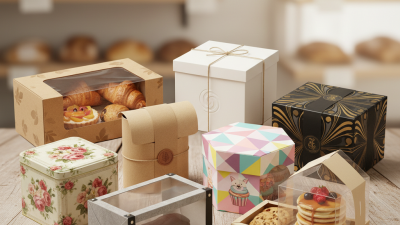
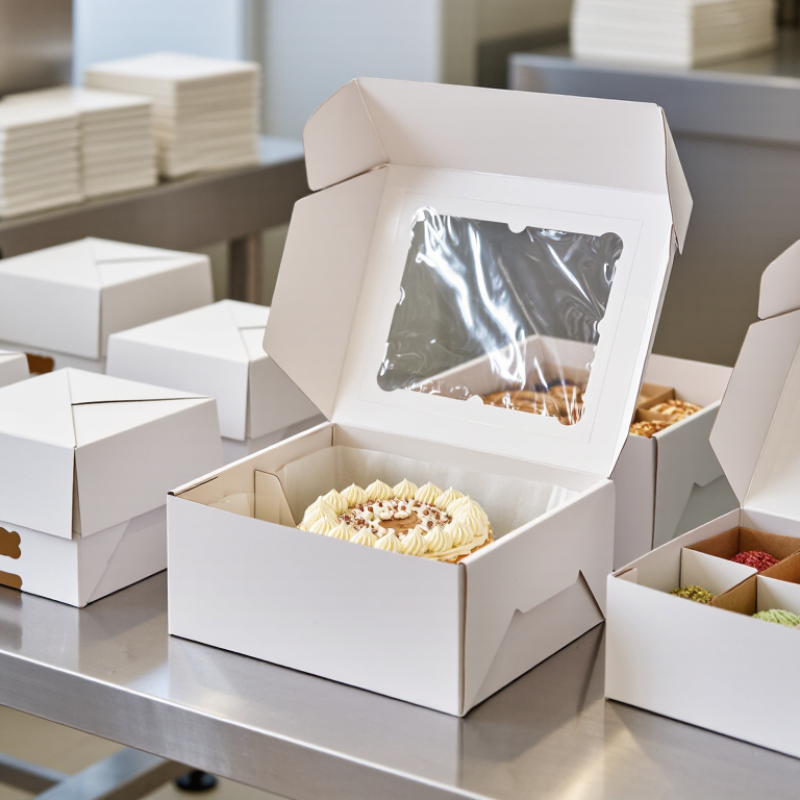
Lisa McTigue Pierce, a packaging industry expert, once called packaging “a brand’s silent salesperson.” That’s so true in pastry retail. A rigid White Box with a secure locking base can make a birthday cake feel like a bigger deal. A small window can show off the product without making the box weak. But looks alone won’t cut it. Ask suppliers about paperboard grade, coating options, printing accuracy, odor control, and edge compression testing. And yes—request physical samples before you approve mass production.
Experience often uncovers things a quotation never will. Does the box stay square after refrigeration? Can the ribbon handle humid storage? Will the logo stay sharp next to a greasy pastry? These are fair questions, and they deserve clear answers. A dependable Chinese supplier should give you material specs, factory photos, sample records, and realistic lead times. Check certifications through valid documents, too—not just casual claims.
There’s no perfect supplier.
A low minimum order might push unit costs up. A premium finish might make recycling harder. I wouldn’t pick the cheapest factory without testing. That route can lead to damaged products, delayed launches, and a lot of unnecessary waste. This guide will compare supplier capabilities, customization, quality control, communication, and shipping performance—so buyers can make a more informed Pastry Packaging Box decision.
What Defines the Best Pastry Packaging Box Supplier in China?
Best Pastry Packaging Box Supplier in China?
The best supplier is defined by more than a low quotation. It should understand butter migration, moisture control, stacking pressure, and delivery temperature. In practical pastry production, a box must protect fragile corners without crushing flaky layers. Small details matter. Ask for food-contact material declarations, migration test reports, and traceable batch records. These documents show professional control, not just attractive samples.
Material choices also need evidence. FAOSTAT reported global paper and paperboard production of about 417 million tonnes in 2021, showing the scale of fiber packaging. However, volume does not equal sustainability. McKinsey’s 2023 global packaging survey found that environmental impact ranks among important consumer purchase considerations, while price and performance remain decisive. A reliable Chinese supplier should therefore offer recyclable paperboard options, responsible coating choices, and clear disposal guidance. “Eco-friendly” alone proves little.
Experience appears during testing. Request samples with the actual pastry size, filling weight, oil level, and storage conditions. Check lid fit after refrigeration. Check print quality after condensation. Independent laboratory testing is preferable to unsupported claims. I would also review production capacity, defect controls, lead times, and export documentation. No supplier is perfect. Even a strong factory may overlook a weak locking tab or underestimate seasonal demand. The best partner welcomes those uncomfortable findings and corrects them before mass production.
Barrier Performance: Grease Resistance and WVTR Below 10 g/m²·day
Best Pastry Packaging Box Supplier in China?
For pastry packaging, barrier performance deserves more attention than attractive printing. Butter, cream, and fillings can quickly stain paperboard. A reliable Box Pastry design should resist grease during storage, transport, and display. Ask suppliers for grease-resistance test results, not only product photographs. Testing methods and contact time must be clearly stated. A box that performs well for dry cookies may fail with warm croissants.
WVTR below 10 g/m²·day can help limit moisture transfer, but the test conditions matter. Temperature, humidity, coating weight, and board structure can change the result. Request reports showing the test standard, laboratory details, and measured values. I would also inspect production samples. Weak corners, uneven coatings, or poor folding can reduce protection. The number alone is not enough.
Tips: Place a buttery pastry inside the sample box for several hours. Check oil marks, softened panels, and lid stability. Test the box after refrigeration and room-temperature exposure. Ask whether the supplier controls coating thickness during production. A small trial order is safer than approving a large shipment immediately. Packaging tests can miss real handling problems. That is worth remembering.
How to read this chart: A WVTR below 10 g/m²·day is used here as the barrier screening target for pastry packaging. Water-based dispersion-coated paperboard is shown at the target level, while aluminum-laminated paperboard provides the strongest moisture barrier. Grease resistance is rated from 1 (low) to 5 (very high).
Representative benchmark values under typical laboratory conditions around 23°C and 50% relative humidity. Actual results vary with coating weight, board structure, sealing quality, test method, and package converting conditions.
Printing Quality: CMYK, Pantone Matching, and ±0.1 mm Die-Cut Tolerance
A reliable pastry packaging box supplier in China should prove printing quality before quoting volume. Smithers’ The Future of Global Packaging to 2028 estimates the global packaging market will exceed 1 trillion US dollars annually. That scale makes repeatable colour control commercially important, not decorative. For CMYK artwork, request calibrated proofs, press sheets, and production samples. ISO 12647-2 provides process-control guidance for offset printing. A serious factory should record ink density, substrate, drying conditions, and colour differences between batches.
Pantone matching helps protect a signature shade across coated paper, kraft board, and laminated surfaces. However, a printed colour chip is not a guarantee. Paper whiteness and varnish can shift the result. Ask for an approved physical drawdown under standard lighting. A practical contract may set a buyer-defined Delta E 2000 target, such as ≤2.0, rather than accepting “close enough.” Human viewing still introduces judgement. It is not perfect.
Die-cut accuracy matters around window openings, folds, and pastry-lock tabs. A ±0.1 mm tolerance sounds precise, but it must include the board thickness, machine setup, and measurement method. Request first-article inspection, calibrated digital measurement, and samples from different production times. The supplier should show whether tolerance applies to every edge or only critical features. In my experience, attractive samples can hide weak repeatability. That deserves scrutiny. Supplier selection should reward documented control, not polished promises.
Supplier Capacity: MOQ, 15–30-Day Lead Times, and 100% Quality Inspection
Choosing the best Pastry Box supplier in China requires more than attractive samples. Capacity must match your sales rhythm, storage limits, and launch schedule.
Ask for a clear MOQ by size, material, printing method, and finish. A practical supplier may offer 1,000–3,000 boxes for standard designs, while custom foil details usually require more. Confirm whether the 15–30-day lead time starts after artwork approval or deposit payment. That difference can disrupt a bakery promotion. I have seen cartons arrive on schedule, yet labels were delayed because nobody defined the starting point.
Quality control should be measurable. A serious factory can inspect every box for dimensions, color, glue strength, window alignment, and surface marks. The phrase “100% inspection” needs evidence: inspection checklists, defect photos, batch records, and retained samples. Sampling standards such as ISO 2859-1 remain useful, but full inspection is stronger for premium pastry packaging. It also costs more.
Eurostat reported 186.5 kilograms of packaging waste per EU resident in 2022. That figure pressures suppliers to reduce unnecessary layers and improve material choices. Smithers’ packaging research also identifies sustainability and shorter supply chains as major industry priorities. Ask for paper specifications, food-contact documentation, and realistic production capacity. A supplier promising unlimited output deserves careful questioning. Even excellent factories can struggle during holiday peaks.
How to Compare Chinese Suppliers by Cost, Certifications, and Samples
Best Pastry Packaging Box Supplier in China?
Comparing Chinese Pastry Box suppliers requires more than reading the lowest quotation. Request a cost sheet showing board grade, printing, inserts, tooling, packing, and delivery terms. A smallPink Pastry Box may need thicker board if it carries buttercream or warm pastries. Ask for pricing at three volumes, such as 1,000, 5,000, and 20,000 units. This exposes hidden scale savings. Confirm whether food-contact materials meet the destination market’s requirements. The quotation should also state measurement tolerances and replacement terms.
Certifications need verification, not decoration. The ISO Survey 2023 recorded more than one million ISO 9001 certificates worldwide, but certification alone does not prove strong pastry-box production. Check the certificate number, scope, expiry date, and issuing body. For paper sourcing, FSC Facts & Figures 2023 reported over 160 million hectares of certified forest area globally. Still, request chain-of-custody evidence for the actual board. Samples reveal more. Order an unprinted sample, a production-color sample, and a filled transport sample. Test lid fit, corner strength, grease resistance, odor, and stacking after 24 hours. Ask for material reports and migration testing where required. I would also compare color consistency across samples, because one attractive prototype can hide unstable production. This method is not perfect. Supplier replies may remain selective. Use dated photos, video inspections, and a signed specification to reduce uncertainty.
Best Pastry Packaging Box Supplier in China? - How to Compare Chinese Suppliers by Cost, Certifications, and Samples
| Supplier Profile | Typical Product Scope | Indicative Unit Cost
(USD, 1,000 pcs) | Minimum Order Quantity | Production Lead Time | Certification & Compliance Evidence | Sample Policy | Best Fit | Overall Score |
Profile A
Value-focused converter | Folding Pastry Boxes, coated paperboard, standard die-cut styles | $0.12–$0.22 | 3,000–5,000 pcs | 18–25 working days | FSC material option; food-contact declaration available; ISO 9001 evidence should be verified before order | Plain or digital prototype; tooling and courier costs usually charged separately | Price-sensitive buyers with standard dimensions | 8.1/10 |
Profile B
Mid-range custom printer | Custom-printed cake and Pastry Boxes, window boxes, specialty finishes | $0.18–$0.34 | 2,000–3,000 pcs | 20–28 working days | FSC-certified board available; ISO 9001 commonly available; ink and adhesive compliance documents should be requested | One digital sample included; physical color proof may carry an additional fee | Retail pastry brands requiring attractive print quality | 8.8/10 |
Profile C
Food-packaging specialist | Grease-resistant pastry packaging, bakery trays, food-safe printed cartons | $0.22–$0.40 | 5,000–10,000 pcs | 25–35 working days | Food-contact test reports; migration testing available; BRCGS Packaging Materials or equivalent evidence should be confirmed by audit | Material and structural samples available; testing fees may apply | Exporters needing stronger food-safety documentation | 9.2/10 |
Profile D
Premium rigid-box producer | Rigid Pastry Gift Boxes, magnetic closures, foil stamping, inserts | $0.65–$1.80 | 1,000–2,000 pcs | 30–45 working days | FSC paperboard options; food-contact suitability depends on the inner lining and insert materials; third-party testing recommended | Paid pre-production sample; prototype approval normally required before mass production | Premium gifting, seasonal collections, and high-end presentation | 8.4/10 |
Profile E
Sustainable packaging producer | Recyclable paperboard boxes, water-based coatings, plastic-free window options | $0.20–$0.38 | 3,000–5,000 pcs | 22–32 working days | FSC-certified or recycled-board options; recycling claims should be supported by material specifications and local-market requirements | Standard sample usually available; custom sample charged according to artwork and tooling | Brands prioritizing recyclable materials and sustainability claims | 8.9/10 |
Comparison note: The prices shown are indicative FOB China ranges for common paperboard pastry packaging and can vary according to board grade, dimensions, printing coverage, coating, window material, inserts, order volume, tooling, and shipping terms. Request current quotations, test reports, certificates, and a production sample before placing an order.
Eco-Friendly Degradable Corrugated Cake Boxes: A Complete Guide from China Suppliers
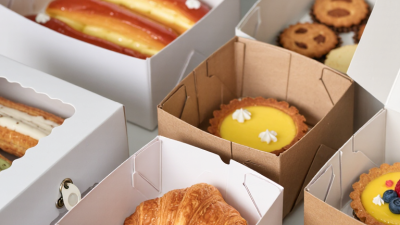
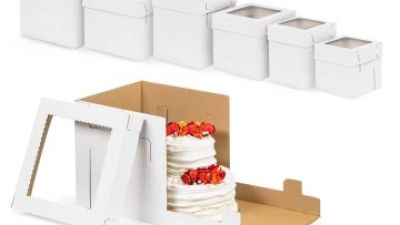
Eco-friendly degradable corrugated Cake Boxes offer a practical way to protect premium baked goods while reducing reliance on plastic packaging. Made from paper-based E-flute corrugated cardboard, these boxes combine a lightweight structure with dependable strength. Their rigid construction helps prevent crushing, vibration damage, and surface contact during delivery, keeping cakes neat and presentable from the bakery to the customer.
The sleek white exterior creates a clean, professional appearance, while the warm kraft-paper interior adds a natural and welcoming touch to the unboxing experience. The paper-based design is suitable for recycling where local facilities accept corrugated materials, helping bakeries pursue more responsible packaging practices without compromising presentation or performance. Proper sizing and secure closure can also improve product stability and reduce unnecessary packing materials.
As an experienced China supplier and factory, we provide corrugated cake boxes for international bakery chains, catering businesses, and professional packaging companies. Available production support may include tailored dimensions, structural adjustments, and surface customization to meet different cake sizes and presentation requirements. With reliable protective performance and an appealing eco-conscious look, these boxes help businesses deliver cakes in excellent condition while presenting a more sustainable packaging choice.
Conclusion
Choosing the best Pastry Packaging Box supplier in China requires more than comparing prices. A dependable supplier should offer suitable materials, such as 250–400 GSM paperboard or 32 ECT corrugated board, with reliable food-contact compliance under GB 4806, FDA 21 CFR, and EU 1935/2004 standards. Packaging should also provide strong grease resistance and a water vapor transmission rate below 10 g/m²·day to help preserve product quality.
Printing and production accuracy are equally important. Look for suppliers capable of consistent CMYK printing, accurate Pantone matching, and die-cut tolerances of approximately ±0.1 mm. Before placing an order, compare minimum order quantities, realistic 15–30-day lead times, production capacity, and documented 100% quality inspection procedures. Requesting material samples, printed prototypes, compliance documents, and clear quotations can help evaluate suppliers fairly. The best choice balances product safety, appearance, durability, customization, delivery reliability, and overall cost.
 +86-18394093613
 Contact Phone
 Contact Email