 +86-18394093613


Leave Your Message



0102030405
Cake Box Window Film: PET, PVC and PP Selection with Food-Contact Compliance
2026-09-23
Cake Box Window Film: PET, PVC and PP Selection with Food-Contact Compliance for B2B Buyers
When bakery chains, packaging distributors and cake supply wholesalers negotiate a custom cake box program, the conversation usually lands on board stiffness, print quality and pallet height. The transparent window film is treated as an afterthought—until a pallet of boxes arrives with cloudy panels, lifted corners or a faint plastic odor that triggers a retailer audit. For food brand owners shipping private-label desserts into supermarkets, the window is not decoration; it is the single surface the shopper touches with their eyes before they touch the product with their hands. This guide treats window film as a specification item in its own right, with measurable properties, named compliance frameworks and a clause you can drop into a purchase order.
Why the Window Film Deserves Its Own Specification Line
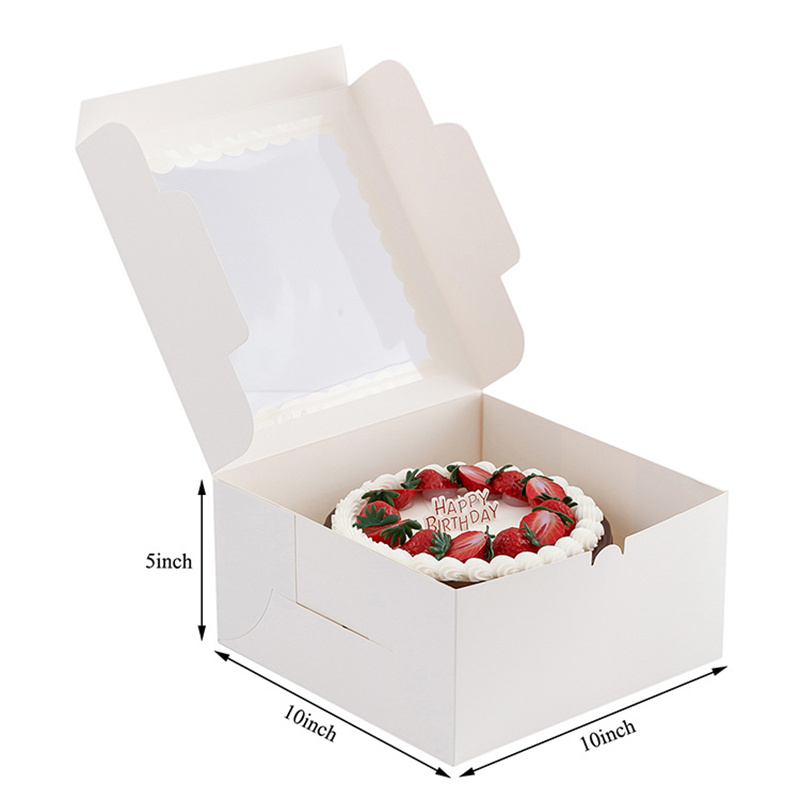
A window film looks like a few grams of plastic, but it carries disproportionate risk across the supply chain. It is the only packaging component that is both in direct sight of the consumer and in indirect contact with the food through the air gap. It also behaves differently from the paperboard during printing, die-cutting, folding and transit. Buyers who lump it under "box accessories" routinely miss three failure modes: optical clouding after storage, adhesive ooze at the cut edge, and non-compliant plastic entering a regulated food-contact stream.
The practical answer is to separate the film from the carton in your documentation. Define the film material, thickness, optical values, adhesive system and compliance status as standalone sub-parameters, then reference them from the master box specification. This keeps a Chinese factory such as a Yiwu-based supplier honest when you reorder eighteen months later and the resin grade has quietly changed.
Material Comparison: PET, PVC and PP
Three thermoplastics dominate the cake box window market. Each has a distinct cost, optical and regulatory profile, and none is universally correct.
PET: Clarity and Rigidity
Polyethylene terephthalate (APET or PETG for some cold-form grades) is the premium default for gift-grade Cake Boxes. It delivers the highest light transmission of the three—typically88% to 92% total light transmission at 200–350 µm—and holds a flat, rigid panel that resists the "pillow" wrinkle you see in cheaper films. PET also survives the humidity of a chilled display case better than PVC and does not plasticize toward the food. The trade-off is price: PET resin runs roughly 15%–35% above PVC on a per-square-meter basis, and it needs a hotter, more controlled bonding step.
PVC: Low Cost with an Environmental Question Mark
Polyvinyl chloride remains the cheapest clear film and the easiest to heat-weld, which is why it still appears in budget bakery lines. But PVC carries two liabilities that matter to B2B buyers in 2026. First, chlorine chemistry makes it unwelcome in many municipal recycling streams, and several European retailers now ask suppliers to phase it out. Second, plasticizer migration and dioxin concerns during incineration put it under steady regulatory pressure. For distributors serving eco-positioned grocery chains, specifying PVC is increasingly a liability rather than a saving.
PP: Microwave Use and Food-Contact Stability
Polypropylene offers the best combination of microwave tolerance and inertness. It withstands microwave reheating without softening, and its low extractables make it a safe choice for direct or near-direct food contact. Its weakness is optics: biaxially oriented PP (BOPP) typically tops out near 85%–90% transmission with slightly higher haze than PET, and it is more prone to static cling and creasing during high-speed windowing. PP is the rational pick for heat-and-eat bakery SKUs and for brands targeting recyclable mono-material structures.
Light Transmission and Haze: The Visible Quality Metrics
Clarity is not a feeling; it is two numbers on a spectrophotometer. Total light transmission measures the percentage of visible light passing through the film, while haze measures the percentage of that transmitted light scattered by the film surface and internal structure. For a premium cake window you generally want transmission above 88% and haze below 4%. Below 85% transmission or above 8% haze, the cake reads as "under glass in a dim room" rather than "fresh on the shelf."
- Premium PET window: 90%–92% transmission, 1.5%–3.5% haze
- Standard BOPP window: 84%–89% transmission, 3%–7% haze
- Recycled-content PET: 86%–90% transmission, 4%–9% haze (acceptable for non-gift lines)
- PVC legacy film: 88%–91% transmission, 2%–5% haze, but with the recycling penalty above
Request the supplier's per-batch optical report rather than a single marketing claim. Haze creeps up as extrusion cooling drifts or regrind percentage rises, and that drift is invisible until the carton is stacked under retail lighting.
Die-Cut Window and Adhesion: Glue Compatibility and De-lamination Risk
The window is applied by a patching machine that deposits a bead of adhesive around a die-cut aperture and presses the film onto the carton. The failure mode buyers fear is the corner that lifts in transit, exposing a ragged paper edge and a gap that collects crumbs. Lifting is almost always an adhesive–film mismatch, not a machine fault.
- Water-based acrylic emulsions bond well to PET and PP but need a longer dwell and pressure; under-cure leaves a soft, peelable bond.
- Hot-melt adhesives grab fast and suit high-speed lines, yet some formulations bloom or stiffen at cold-chain temperatures and lose tack below 4°C.
- Solvent-free PU (polyurethane) two-component systems give the highest peel strength—often 3–6 N/15 mm on PET—and are the choice for heavy or large windows.
Specify the minimum peel strength at 23°C and at 4°C separately, because a bond that passes at room temperature can fail in a refrigerated truck. Ask for the adhesive's food-grade certificate and confirm it is applied only to the outer carton face, never bridging into the food cavity.
Tip: Always request a 7-day humid-ageing peel test at 85% RH before approving a new window film and adhesive combination for production.

Food-Contact Compliance: FDA 21 CFR and EU 10/2011
For boxes sold into the United States, the window film and its adhesive must meet FDA 21 CFR requirements for food-contact materials. PET and PP are listed under the relevant indirect-additive provisions, while the adhesive used at the window edge is covered under its own compliance letter. For the European Union, Regulation (EU) 10/2011 governs plastic food-contact materials and sets specific migration limits, with overall migration capped at 10 mg/dm² and individual substances controlled by their specific migration limits.
Two practical points for buyers. First, a "food-safe box" claim is not enough; you need the film's and adhesive's individual declarations, because a compliant carton board can sit next to a non-declared film. Second, if the window can contact the product—common with flexible flow-wrap style windows or with cream that presses against the panel—the material moves from "indirect" toward "direct" contact and the documentation burden rises accordingly. Keep a folder with the supplier's EU 10/2011 and FDA letters of compliance version-controlled by lot.
Two-Component Adhesives and Food-Grade Certification
When a window is large or the box is handled roughly at point of sale, converters reach for two-component polyurethane adhesives. These deliver strong, durable bonds but introduce a curing chemistry that must be fully reacted before food contact. An under-cured two-part adhesive can release residual isocyanates or monomers, which is precisely the migration risk regulations target.
- Require a food-grade certificate naming the exact adhesive product code and batch.
- Confirm the stated curing window (often 24–72 hours at controlled temperature) was met before cutting and packing.
- Ask for a declaration that no non-compliant photo-initiators or restricted substances are present.
- Track the adhesive lot against the film lot so a future audit can reconstruct the build.
This discipline protects distributors when a retailer's quality team pulls a random box for third-party migration testing; you can answer with a dated certificate instead of a promise.
Recycling Stream Impact and Mono-Material Design
A windowed box is fundamentally a multi-material object: paperboard plus a plastic patch plus an adhesive layer. In most curbside streams that combination is rejected unless the consumer removes the film, which they rarely do. The industry response is the mono-material trend—using a PP or PET window with a compatible, separable or low-contamination bond so the carton can enter paper recycling with reduced penalty, or designing the window to be easily tear-away.
Buyers specifying for sustainability programs should weigh three routes: (1) a recyclable PP window with a debond-on-repulping adhesive that lets the plastic float off during pulping; (2) a reduced-window or no-window design for non-gift SKUs; (3) a PET window where local infrastructure actually recovers PET. None is free; each shifts cost or appearance, so decide against the end-market's actual recovery capability rather than a generic "eco" label.
Anti-Fog Coating and Cold-Case Display
Cake Boxes destined for refrigerated display face a specific optical problem: moisture condenses on the inner film surface and turns the clear window into frosted glass. Anti-fog treatment—a hydrophilic coating or masterbatch that spreads condensate into a thin, invisible film—restores visibility. For chilled cheesecake, mousse and cream-line products, anti-fog is not a nice-to-have; it is what keeps the product selling at hour six of the display day.
- Specify anti-fog performance as a timed test, e.g., no fogging for 60 minutes at 4°C after a 25°C ambient transfer.
- Confirm the coating itself is food-contact approved and does not flake into the cavity.
- Note that anti-fog reduces headline transmission by roughly 1–3 points; budget for it in your clarity spec.
Writing the Window Film Clause in Your Purchase Specification
The cleanest way to control quality is a dedicated window-film paragraph in the purchase order. A usable clause lists material, thickness, optical values, bond strength and compliance by name. A template distributors use:
- Material: APET (or BOPP / PVC, stated explicitly—never "clear film").
- Thickness: 250 µm ± 15 µm (state the µm range you accept).
- Light transmission: ≥ 88% as measured per ASTM D1003.
- Haze: ≤ 4% as measured per ASTM D1003.
- Peel strength: ≥ 4 N/15 mm at 23°C and ≥ 3 N/15 mm at 4°C.
- Adhesive: named two-component PU, food-grade certified, outer-face only.
- Compliance: FDA 21 CFR and EU 10/2011 declarations on file, lot-traceable.
- Optional: anti-fog coating for cold-chain SKUs, with timed performance.
Hand this clause to the factory during sampling, not after the first container. It converts a vague "clear window" into a testable, rejectable, reorderable definition—which is the whole point of buying at B2B volume.
FAQ
Which window film is best for a premium Gift Cake Box?
APET is the usual answer. Its 90%–92% transmission and sub-4% haze give the crispest view, and its rigidity keeps the panel flat through folding and shelf life. The cost premium over PVC is usually 15%–35% per square meter, which is small against the retail price of a decorated celebration cake.
Is PVC still acceptable for Food Packaging?
It is not banned everywhere, but it is increasingly unwelcome. PVC films can be food-contact compliant in many jurisdictions, yet their recycling penalty and regulatory pressure make them a poor long-term choice for distributors supplying Western grocery chains. Specify PP or PET unless a buyer explicitly requests PVC and accepts the end-of-life story.
How do I prevent window corners from lifting during shipping?
Lifting is an adhesive–film mismatch, not bad luck. Require a named adhesive, specify minimum peel strength at both 23°C and 4°C, and run a 7-day humid-ageing peel test before production. Most lifting disappears once the bond is qualified at cold-chain temperature rather than only at room temperature.
Does the window film need its own food-contact certificate?
Yes. A compliant carton board does not certify the film or the adhesive at the window edge. You need separate FDA 21 CFR and EU 10/2011 declarations for the film and for the adhesive, version-controlled by lot so a future audit can be answered with documents rather than recollection.
Can a windowed Cake Box be recycled?
Only with design intent. A standard paper-plus-plastic window is usually rejected by curbside paper streams. Use a debonding adhesive that lets the plastic separate during repulping, a mono-material PP window, or a reduced-window design. Match the choice to the recovery infrastructure of your actual end market.
When is anti-fog window film worth the cost?
For any Cake Box held in a refrigerated or high-humidity display—cheesecakes, mousses, cream-line and fresh-fruit toppings. Anti-fog keeps the product visible through the condensation cycle and typically costs a few percent more while protecting the sale at the shelf.