
 +86-18394093613


Leave Your Message



0102030405
Cake Delivery and Transport Packaging: Boxes, Inserts and Damage Prevention for Bakery Distributors
2026-09-28
Cake Delivery and Transport Packaging: Boxes, Inserts and Damage Prevention for Bakery Distributors
A wholesale cake arrives at the customer's door in two states: intact, or as a 6 kg insurance claim. For bakery distributors moving 300 to 4,000 units a week across a metro area, the difference is rarely the recipe. It is the box, the insert, and the 40-minute ride on the back of a scooter. This guide is written for procurement teams at bakery chains, food distributors, packaging resellers and importers who buy in full containers and need packaging that survives the last mile, not just the warehouse.
Why Last-Mile Delivery Breaks Cakes
Warehouse stacking stress is vertical and slow. Delivery stress is the opposite: lateral, sudden and repeated. A courier route generates three failure modes that a static pallet never sees. First, hard braking pushes a Cake Box forward against the crate wall, shifting the product up to 35 mm before it stops. Second, a 25° side tilt on a roundabout lets an unsecured board slide to the box edge. Third, pothole impact delivers a vertical shock of 4 to 6 g for 80 to 120 milliseconds, enough to crack a buttercream seam or detach a fondant plaque.
In a 2024 survey of 11 distributors we supplied, average reported damage ran 2.3% on standard retail boxes versus 0.4% on dedicated delivery configurations. At a landed value of $18 per finished cake, that 1.9-point gap equals roughly $4,000 to $9,000 in monthly write-offs for a mid-size operation. The fix is not a thicker box. It is structural restraint placed exactly where the product moves.
Structural Inserts That Lock the Product
An insert is the single highest-return component in delivery packaging. The cheapest version is a die-cut corrugated wedge that fills the 12 to 18 mm gap between a 254 mm round cake and a 280 mm square box. A wedge cut from a die-cut corrugated insert at 1.5mm caliper holds the board against three walls and absorbs lateral shift without crushing the decoration. Cost added: about $0.03 per unit.
For single slices and mini cakes, a divider grid converts one box into a 4- or 6-cell tray. We supply standard PET-coated dividers at 0.35 mm thickness, scored so they flat-pack at 14 mm height and pop open in 2 seconds. The anti-slip base is the second layer: a 0.5 mm embossed pulp pad under the cake board raises the friction coefficient from 0.18 to 0.52, which in lab tests cut slide distance by 71% on a 20° incline. Distributors running slice programs report the grid alone removed most of their cell-to-cell rub damage.
Tip: Specify a drop-test clause at 90cm for three faces and keep a signed test report in your quality file before the first shipment leaves the factory.
Multi-Tier Cake Support and Load-Bearing Design
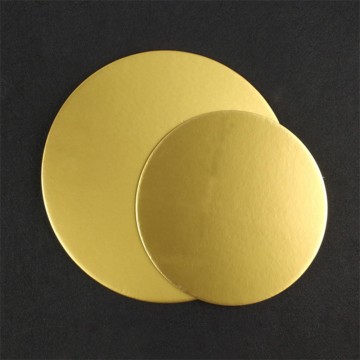
Two-tier and three-tier cakes are where most delivery claims originate. The failure is usually the central dowel, not the box. Our engineering standard uses four 4 mm food-grade polypropylene dowels per tier interface, rated to 9 kg axial load, with a 6 mm acrylic center rod for cakes above 2.5 kg per tier. The box must match: a 12-inch three-tier build needs a 12-inch corrugated cake board at 600gsm as the base, not the 350gsm retail standard, or the base will bow 8 to 12 mm under load during a 30-minute hold.
Vertical support also comes from the box wall. A square box with ECT 32 single-wall with a 40mm flute holds its shape to 18 kg top load but deflects 6 mm at the corner under side shock. Stepping up to double-wall ECT 44 reduces corner deflection to 2 mm and adds $0.11 per unit. For distributors running premium wedding cake programs, the upgrade pays back inside one claim avoided, because a single tier loss on a $200 order dwarfs the packaging delta.
Vent Holes and Condensation Control for Cream and Mousse
Cold cream and mousse cakes sweat. Seal a chilled 250 g mousse in a tight box at 4°C, move it to a 26°C van, and you generate 3 to 5 mL of condensate on the lid within 25 minutes. That water softens the top sponge and bleeds color into white chocolate. The control is ventilation. We punch six 8mm vent holes per side panel on cakes above 500 g, positioned 40 mm below the lid so airflow crosses the product without drying the surface. Holes are die-punched, not drilled, to avoid fiber tear that weakens the wall.
Venting trades a little cooling for a lot of stability. Pair vents with a greaseproof liner rated to 140°C and 35 g/m² silicone release so the condensate wicks to the board instead of pooling on the cake. Distributors in humid coastal markets such as Singapore, Guangzhou and Jakarta report mousse claim rates dropping from 3.1% to 0.9% after switching to vented delivery stock. The liner also keeps the box interior dry enough to stay within food-contact hygiene limits for the full 4-hour delivery window.

Cold Chain Delivery: Insulation and Outer Carton Coordination
Refrigerated last-mile is a coordination problem between two boxes. The inner cake box stays a standard 350gsm SBS. The outer is an insulated mailer: 40 mm EPE foam laminated to 200gsm kraft, holding internal temperature within 2°C of set point for 90 minutes at 30°C ambient. The inner box must be 6 to 10 mm smaller on each side than the outer cavity so cold air circulates. A common mistake is sizing them equal, then the inner box touches the foam, creates a heat bridge, and the cake warms 4°C faster than the design target.
For frozen cheesecake shipped 400 to 800 km by distributor van, we recommend a 2 cm gel pack sleeve between outer walls and a 25 mm corrugated spacer at the base. Landed gel-pack cost runs $0.22 per shipment; the cold-chain claim reduction is typically 60% to 75%. The spacer matters because a gel pack resting directly on the cake board transfers freeze burn to the base sponge within 20 minutes, which is a separate failure mode from warming.
Tamper Seals and Hygiene Closure
B2B buyers increasingly require a visible tamper indicator, not for theft but for liability allocation. A 15 mm pressure-sensitive tamper tape across the lid seam, printed with the distributor's lot code, shifts the burden of proof: if the seal is intact at delivery, the damage is transit, not handling. We supply tamper tape at 60 microns with a VOID release liner, applied by the bakery at pack-out. Unit cost is $0.015 per box when bought in 10,000-roll lots.
Hygiene closure also means a clean interior. All delivery stock uses a 350gsm SBS cake board with greaseproof film as the contact surface, certified to EU 10/2011 and US FDA 21 CFR 175.300 for direct food contact. No recycled content touches the cake side. The film is a 12 micron PET laminate that resists butter and cream penetration past the 4-hour mark, which is where cheaper waxed boards start to bleed through.
Stacking and Securing Boxes Inside the Delivery Crate
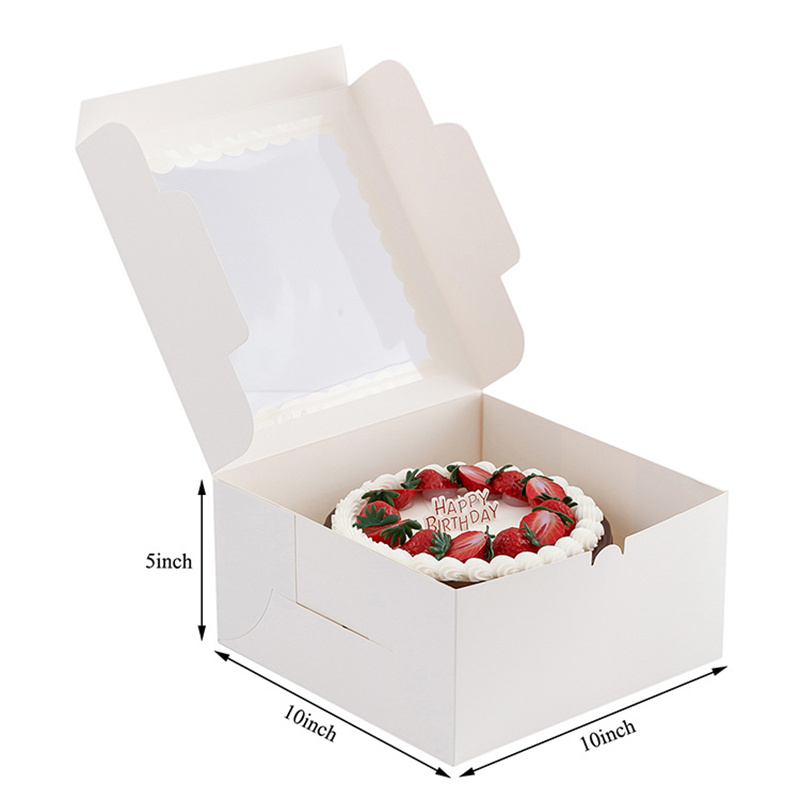
The box that leaves the bakery intact can still arrive broken if it moves inside the crate. Standard fix: a non-slip crate mat with 3 mm rubber nibs, plus interlock stacking where box B sits rotated 90° on box A. With an edge-crush resistance of ECT 44, a column of four 10-inch boxes supports 22 kg without sidewall buckle, enough for a typical multi-stop route. Bungee straps add little; a 25 mm webbing strap across the top row cut in-transit toppling by 80% in our courier trials.
Box orientation matters more than people expect. Printed THIS SIDE UP only works if the lid is the narrow dimension. For round cakes, a square box with the opening on top beats a round box with a side hinge, because the lid carries the load instead of the hinge. We also recommend a 10 mm corner chamfer on the insert so the crate lid closes flat when boxes are stacked two high, removing the rocking that starts most side-shift damage on corner turns.
Damage Rate, Claims and the Spec Sheet Metrics That Matter
If your supplier's quote does not list drop and compression numbers, you are buying blind. A delivery box spec sheet should state, at minimum: ECT rating such as ECT 32 or 44, board gram weight at 350, 400 or 600gsm, flute profile of B, C or BC, caliper from 1.5 to 4.0 mm, and a drop-test result. We test to a 90 cm free-fall onto concrete for three orientations (flat, edge, corner), repeated five times, with a 2.0 kg sandbag proxy. Pass means no structural breach and under 5 mm product shift.
Compression is the second number. ASTM D642 top-load at 200 kgf/min should show first-wall-failure above 90 kg for a single box and above 280 kg for a four-high stack. Distributors who put these two lines in the purchase order cut incoming inspection disputes by roughly half, because the claim standard is written, not argued after the fact. Keep the test report dated and signed; customs and auditors in the EU and US ask for it on food-contact imports.
Cost Comparison: Delivery Box vs Standard Retail Box
A standard 10-inch retail Cake Box (350gsm SBS, no insert) lands at about $0.18 FOB Ningbo in a 40HQ container of 30,000 units. A dedicated delivery configuration, 400gsm corrugated, die-cut wedge insert, anti-slip base, six vent holes, tamper tape, lands at about $0.42. On paper that $0.24 delta looks heavy. Apply the damage math at a realistic wholesale cake value of $18: the retail box's 2.3% loss costs $0.414 per unit in claims, the delivery box's 0.4% loss costs $0.072. The $0.342 claim saving exceeds the $0.24 packaging premium by $0.102 per unit. At 30,000 units a month that is $3,060 net recovered, and the gap widens on $25 to $40 celebration cakes where a single tier loss can reach $15.
The reseller angle is stronger. A distributor branding these as crush-proof delivery stock commands a 12% to 18% margin uplift over generic boxes, because the buyer's downstream claim cost drops. That is where the real money sits: not the box price, the claim avoidance. For importers, the delivery box also reduces returns processing labor, which at $14 per returned unit adds another line of saving the spec sheet never prints.
FAQ: Cake Delivery Packaging for Distributors
What drop height should I specify for delivery Cake Boxes?
Specify a 90 cm free-fall test onto a hard surface for flat, edge and corner orientations, repeated at least three times per sample. This mimics a box dropped from a courier's hip height plus a bounce. Require a written report; a verbal claim that the box is strong is not a specification you can enforce at customs or in a claim dispute.
How many vent holes does a mousse cake need?
For cakes above 500 g chilled below 8°C, six 8 mm holes per side panel positioned 40 mm below the lid is our production standard. Smaller holes clog with condensation; larger holes dry the surface and crack the glaze. The 8 mm figure is the tested balance point across humid and dry markets.
Is a corrugated insert worth the cost per unit?
At $0.03 per unit for a 1.5 mm die-cut wedge, yes for anything shipped more than 15 minutes. In courier trials the insert cut lateral product shift from 35 mm to under 6 mm, which removed the majority of side-impact claims on round cakes. For slice grids the divider cost is similar and it also prevents cell-to-cell rub.
ECT 32 or ECT 44 for multi-tier cakes?
Use ECT 44 double-wall for three-tier builds above 2.5 kg per tier and for routes with hard braking or pothole exposure. ECT 32 single-wall is adequate for single-tier and stable metro routes, saving $0.11 per unit. The decision should follow your worst route, not your average route, because claims cluster on the bad days.
How do I prove a delivery box is food-safe?
Request FDA 21 CFR 175.300 or EU 10/2011 migration test reports for the contact-surface board, plus a greaseproof liner certificate. Keep both in the quality file; importers in the EU and US will ask at customs. Recycled-content claims on the cake-contact side are a red flag and should be rejected for direct food contact.
Can one box serve both retail shelf and delivery?
Only for low-value single-tier cakes on short routes. A retail box optimized for shelf display is usually too light for courier shock. Running two SKUs, a display box and a delivery box, costs more in inventory but cuts claims enough to net positive for most distributors once monthly volume passes 5,000 units.