 +86-18394093613


Leave Your Message



0102030405
Grease-Resistant Coatings and Food-Contact Migration Testing for Cake Boxes and Pizza Boxes
2026-09-21
Grease-Resistant Coatings and Food-Contact Migration Testing for Cake Boxes and Pizza Boxes
For bakery chains, packaging distributors, and cake supply wholesalers, the inner surface of a cake box or pizza box is where product quality is won or lost. A cheesecake that bleeds oil through the base, or a pepperoni pizza that saturates its carton after 18 minutes in transit, creates returns, complaints, and re-pricing negotiations that erode margin faster than the packaging line itself. Grease resistance is therefore not a finishing touch; it is a core specification that determines whether a board or box performs under real-world load. This guide compares the main coating technologies used on bakery boards and boxes, explains how food-contact migration testing works, and lays out the exact index a procurement specification sheet should carry.
Why Grease and Moisture Resistance Drive Packaging Decisions
Baked goods release two things that degrade paper-based packaging: free oil (from butter, cream, cheese, and fillings) and water vapor (from warm product and ambient humidity). Uncoated kraft or solid bleached sulfate board typically begins to show oil penetration within 30 to 90 seconds of contact with a fatty surface, and structural softening follows within 2 to 4 hours. For a distributor shipping 5,000 boxes per SKU per month, even a 1% failure rate translates into 50 returned or downgraded units and the associated freight and restocking cost.
The commercial question is not "should we coat?" but "which coating meets our regulatory market, our product fat load, and our end-of-life expectations?" Those three constraints often pull in different directions, which is why a single coating is rarely optimal across an entire catalog.
Coating Technologies Compared: Four Main Approaches
Most bakery boards and boxes on the market today rely on one of four treatments. Each has a distinct cost band, grease-resistance ceiling, and recyclability profile.
PE Lamination (Polyethylene Film)
Polyethylene lamination applies a 12 to 30 micron film of LDPE or HDPE to one or both sides of the board. It delivers the highest grease and moisture barrier among the four options, with oil hold-out measured in hours rather than minutes, and it is the default for frozen Cake Bases and deep-dish pizza where fat load is high. The trade-off is recyclability: a PE-film board is generally not accepted in standard cardboard streams and must go tospecialized plastic-paper separation facilities or be incinerated for energy recovery. Tooling and extrusion costs add roughly 8% to 15% to unit price versus uncoated board.
Wax Coating
Wax coatings, typically paraffin or vegetable wax at 8 to 20 gsm, provide moderate grease resistance and good moisture hold-out at low cost. They are common on economy Pizza Boxes and single-use cake circles. Wax performs poorly above 40°C, where it softens and can transfer to the product, and it blocks standard recycling because wax contaminates the repulping process. Expect wax-coated board to cost 3% to 7% more than plain board.
Silicone Oil Treatment
Silicone release agents are sometimes applied to cake boards to prevent product sticking rather than to block deep grease penetration. They lower the surface energy of the board so creams release cleanly, but they offer only light oil resistance and are usually paired with a separate barrier layer for fatty products. Silicone treatments add 2% to 5% to cost and require careful control so residue does not affect taste.
Fluorine-Free Water-Based Coating
The fastest-growing option is the fluorine-free aqueous barrier coating, a dispersion of acrylic or starch-based polymers applied at 4 to 12 gsm. It provides grease resistance up to kit rating 9 to 12 (the industry standard for oil hold-out), is repulpable in many paper streams, and contains no intentionally added PFAS. Unit cost sits between wax and PE, typically 5% to 10% above plain board. For buyers targeting the EU and North American retail channels, this is increasingly the default compliance choice.
PFAS and Perfluorinated Compound Regulation Trends
Per- and polyfluoroalkyl substances (PFAS) have been used for decades to impart grease resistance because of their extremely low surface energy. Regulators now treat them as a class of persistent, bioaccumulative compounds, and the rulebook is tightening fast. The European Union's proposed restriction under REACH would ban most PFAS in food contact materials, with transition periods debated in the 12 to 36 month range. Several U.S. states, including California, Washington, and New York, have already enacted laws limiting PFAS in Food Packaging, with thresholds commonly set at 100 ppm total fluorine.
For importers, the practical risk is not only current legality but future-proofing. A coating qualified today may be restricted in 18 months, forcing a re-specification across the catalog. The safe procurement posture is to require a total fluorine test below 100 ppm and a written declaration of no intentionally added PFAS from every supplier, refreshed at each annual re-order.
Food-Contact Migration Testing: EU 10/2011 and U.S. FDA 21 CFR 176.170
Migration testing measures what moves from the packaging into the food. The two frameworks buyers encounter most are the EU's Regulation (EU) No 10/2011 and the U.S. FDA's 21 CFR 176.170 for paper and paperboard in contact with aqueous and fatty foods.
Under EU 10/2011, testing uses food simulants chosen by the food type: 3% acetic acid for acidic foods, 10% ethanol for alcoholic and some aqueous foods, 50% ethanol for oil-in-water emulsions, and vegetable oil or 95% ethanol for fatty foods. Conditions are set by time and temperature, for example 10 days at 40°C for long-term room-temperature storage, or 2 hours at 70°C for hot-fill applications. The U.S. FDA 21 CFR 176.170 uses extractives measured in water, 8% alcohol, 50% alcohol, and n-heptane to represent fatty food, with chloroform-soluble extractives capped at 0.5% of the paper weight for most conditions.
Overall Migration vs Specific Migration
Two numbers define compliance and should appear in every specification sheet. Overall migration limit (OML) under EU rules is 10 mg of substances per square decimeter of food-contact surface (10 mg/dm²), a measure of total non-volatile transfer. Specific migration limit (SML) applies to named substances, such as heavy metals or primary aromatic amines, with primary aromatic amines capped at 0.002 mg/kg food. For a Pizza Box with roughly 0.15 m² of interior surface holding a 0.6 kg pie, the allowable total migration is governed by the 10 mg/dm² ceiling scaled to contact area.
Buyers should request the test report naming the simulant, the condition, and the measured value, not just a pass-fail statement. A report that reads "compliant with EU 10/2011" without values is not procurement-grade documentation.
Sensory Testing: Off-Odor and Taste Interference
Beyond chemistry, coatings can affect the eating experience through odor and taste. Sensory testing uses trained panels or instrumental headspace analysis to detect off-notes. The German LFGB §31 sensory test is the common reference, scoring odor and taste on a scale where any distinct foreign note above a threshold fails the article. Wax and some silicone treatments are the usual offenders, particularly when applied heavily or cured at the wrong temperature.
For premium cake brands, a coated board that imparts a waxy or chemical note to a delicate mousse is a reputational risk that no price saving offsets. Sensory sign-off should be a mandatory acceptance criterion for new coating suppliers, run on the actual product, not just on blank board.
Coating Impact on Recyclability
End-of-life behavior is now a downstream customer requirement, not a nice-to-have. Uncoated and lightly aqueous-coated boards generally enter standard OCC (old corrugated containers) streams, while PE-laminated and wax-coated boards are rejected by most municipal recyclers. The European recycling labeling scheme and similar North American programs score fiber-based packaging on repulpability, and a non-recyclable coating can cost a distributor listing access at retail chains with sustainability mandates.
A pragmatic catalog strategy is tiered: use fluorine-free aqueous coating for retail and EU-bound SKUs, and reserve PE lamination for frozen or high-fat food service lines where barrier performance outweighs recyclability. Documenting the coating type on the spec sheet lets buyers route waste correctly.
Tip: Always request a third-party migration and total-fluorine test report dated within 12 months before approving a new coating supplier, not just a self-declaration.
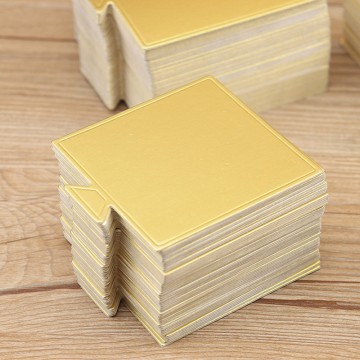
What to Specify in a Procurement Specification Sheet
A procurement specification sheet for coated bakery board should be explicit and measurable. Include the following fields so suppliers quote against the same baseline:
- Base board: grammage range (e.g., 300 to 600 gsm), board type (kraft, SBS, or corrugated), and virgin or recycled content percentage.
- Coating type: PE film, wax, silicone, or fluorine-free aqueous, with applied weight in gsm.
- Grease resistance: kit rating target (typically 8 to 12) per TAPPI T559 or equivalent.
- Moisture barrier: water vapor transmission rate ceiling in g/m²/24h for humid-channel shipments.
- Food-contact compliance: EU 10/2011 and FDA 21 CFR 176.170 reference, with OML and named SML values.
- PFAS status: total fluorine below 100 ppm and declaration of no intentionally added PFAS.
- Sensory: LFGB §31 or equivalent pass on the actual product, odor and taste score recorded.
- Recyclability: coating classified as repulpable or non-recyclable, with end-of-life routing note.
- Migration test recency: third-party report dated within 12 months at first article and at annual re-order.
FAQ
Is PE lamination still acceptable for food-contact Bakery Boxes?
Yes. PE film remains a合规 barrier material under both EU and U.S. food-contact rules and is not a PFAS concern. The limitation is recyclability rather than food safety: most curbside programs reject PE-coated board, so it suits food service and frozen lines more than retail sustainability-driven SKUs.
What kit rating do most wholesale Cake Boards need?
For typical buttercream and fondant cakes, a kit rating of 8 to 10 covers normal handling. High-fat items such as cheeseCake Bases and deep-dish pizza usually require 11 to 12, which points toward PE lamination or a heavy fluorine-free aqueous coating rather than light wax.
How often should migration testing be repeated?
At a minimum, run a full migration and total-fluorine panel at first article approval and then at every annual re-order, or whenever the coating supplier, formula, or base board changes. Some distributors contract a spot check every 6 months on high-volume SKUs as added assurance.
Does a fluorine-free coating perform as well as PFAS treatment?
Modern fluorine-free aqueous coatings reach kit ratings of 9 to 12, which matches legacy PFAS performance for most bakery applications. They are repulpable in many streams and avoid the regulatory exposure, though unit cost is slightly higher than wax and they need validated curing to hit the top grease ratings.
Can wax-coated pizza boxes be recycled?
In most municipal and commercial OCC streams, no. Wax contaminates the repulping process and causes defects in recycled fiber. Wax remains a low-cost option for single-use food service where end-of-life routing is controlled, but it is increasingly excluded from retail sustainability programs.
Which migrating substances matter most for paperboard?
The routinely screened substances are heavy metals, primary aromatic amines, formaldehyde, and phthalates, plus overall migration as a total. For coated board, the coating chemistry itself (residual monomers, silicone oligomers) should be screened under the named regulation rather than assumed inert.