 +86-18394093613


Leave Your Message


0102030405
Import Precautions for Cake Bases
2026-03-06
Import Precautions for Cake Bases
As a core packaging consumable in the baking industry, Cake Bases are the basic carrier for cake shaping, transportation, and display. The compliance and timeliness of their import procurement directly affect the supply chain efficiency and operating costs of baking companies. In the global trade system, different countries and regions have different requirements for the material safety, certification standards, and customs clearance processes for food contact baking packaging. Furthermore, meticulous control over details such as transport packaging, tariff declaration, and risk control is crucial to the smooth import of Cake Bases. This article will outline the key considerations for the entireCake Base import process from five core dimensions: certification compliance, customs declaration, transport packaging, tariff calculation, and risk control, providing professional and practical references for global baking industry buyers.

I. Core Certification Compliance for Imported Cake Bases: Food Contact Safety is Paramount
Cake Bases are baking packaging products that come into direct or indirect contact with food. Food contact safety certification is a fundamental threshold for customs access in various countries. Certification systems differ significantly across markets. Products without the corresponding certification face the risk of customs clearance delays, confiscation, and even fines. Buyers need to confirm in advance whether the supplier's product certification qualifications match the requirements of the target market.
1. Core Certification Requirements for Major European and American Markets
EU Market: Must comply with the EU 1935/2004/EC General Framework Regulation for Food Contact Materials. This regulation explicitly requires that cake base materials meet the core standards of "non-toxic, no harmful substance migration, and traceability." If targeting the German market, LFGB certification is also required. Its testing standards are more stringent, including sensory testing, heavy metal migration testing, and formaldehyde content detection, making it a "golden ticket" for high-end Food Packaging in the EU.
US Market: Must comply with FDA 21 CFR requirements, specifically sections 174-190, which specify migration limits and ingredient declaration standards for Cake Bases made of different materials such as paper, plastic, and wood. While there is no mandatory certification mark, complete third-party compliance test reports must be retained. For the California market, it must also comply with California Proposition 65, which controls carcinogenic or reproductive toxic substances such as lead, cadmium, and bisphenol A.
2. Asia Pacific and Emerging Market Certification Standards
Japan Market: Must comply with JFSL 370 Food Contact Materials Specification, specifying the list of permitted substances and migration limits for Cake Bases, with a focus on controlling fluorescent whitening agents in paper bases and plasticizer content in plastic bases.
South Korea / Australia / Brazil: Must comply with MFDS, AS 2070, and ANVISA standards respectively. The core logic revolves around "safe food contact with no migration," but there are slight differences in testing items and limits; purchasers need to conduct targeted verification.
ASEAN Market: While there is no unified mandatory certification, products must comply with the food packaging safety standards of the importing country. Furthermore, relying on the RCEP Free Trade Agreement, some member states offer tariff reductions for compliant food-grade Cake Trays. It is advisable to confirm qualifications in advance to enjoy these preferential policies.
3. Key Points for General Certification Verification
When selecting cake tray suppliers, buyers need to request test reports issued by authoritative third-party testing institutions (such as SGS and Intertek). These reports must include three core components: material composition, migration detection, and hazardous substance content. Simultaneously, the validity period of the certification certificate should be confirmed. If the product process or materials change, new certification must be obtained to avoid using expired qualifications.
II. Import Customs Clearance Declaration for Cake Trays: Complete and Consistent Documentation is Key
Customs clearance is the core process for importing cake trays. Incomplete declaration documents, inconsistent information, and incorrect coding classifications will all lead to customs clearance delays and increased warehousing and logistics costs. Buyers need to prepare complete documents in advance, standardize the declaration process, and ensure a high degree of compliance with customs review requirements.
1. Required Customs Clearance Documents Checklist
Basic Commercial Documents: Commercial invoice, packing list, bill of lading, trade contract. These must clearly indicate the cake base's name, material (e.g., food-grade cardboard, biodegradable plastic, MDF board), specifications (size/thickness), quantity, unit price, total amount, and country of origin.
Compliance Certification Documents: Food contact safety certification, third-party test report, certificate of origin (required for FTA tariff preferences).
Special Documents: If the cake base uses wooden packaging (e.g., a tray), an ISPM 15 fumigation/heat treatment certificate is required to prevent the spread of harmful organisms. This is a universal requirement for wooden packaging by customs worldwide.
2. Key Points for HS Code Classification
The HS code for the cake base must be accurately classified according to its material, manufacturing process, and intended use. Different classifications correspond to different tariff rates and regulatory conditions. Incorrect classification will lead to incorrect tariff calculations or customs inspections. For example: Paper food-grade cake bases: classified under the paper food packaging code; Plastic transparent cake bases: classified under the plastic food contact products code; Wooden cake bases (food-grade treated): classified under the wooden food packaging code.
It is recommended that buyers, in conjunction with the customs coding rules of the destination country, confirm the accurate codes with suppliers and freight forwarders. For some countries, the first 6 digits of the code are consistent with international standards, while the last 4 digits may have localized adjustments, requiring careful verification.
3. Consistency Requirements for Declaration Information
The product name, quantity, specifications, and country of origin information in the commercial invoice, packing list, bill of lading, and certificate of origin must be completely consistent and match the actual product. For example, the "food-grade" attribute of the cake base must be clearly indicated in all documents. There should be no confusion between "ordinary cardboard base" and "food-grade cardboard base" to avoid customs deeming it a false declaration.
III. Import Transportation and Packaging of Cake Trays: Adaptable Transportation Methods + Compliance Protection for Double Protection
Cake trays are mostly made of paper, thin plastic, or wood, making them susceptible to moisture, deformation, and damage. Different transportation methods (sea/air/land transport) have varying packaging requirements. Furthermore, importing countries have clear restrictions on the environmental friendliness and compliance of packaging materials. Dual control over both transportation and packaging ensures product integrity and avoids customs clearance failures due to packaging violations.
1. Packaging and Protection Requirements for Different Transportation Modes
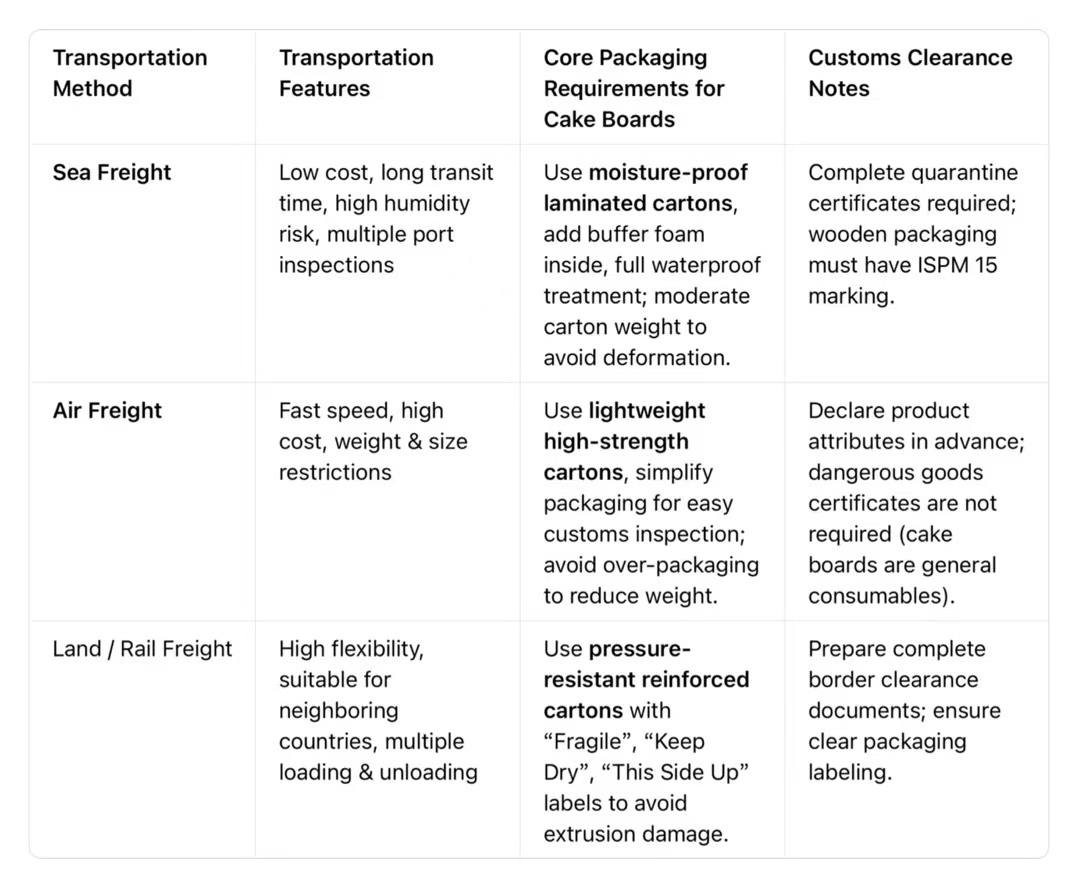
Table: Transportation Mode | Transportation Characteristics | Cake Tray Packaging Core Requirements | Customs Clearance Considerations
Sea Freight | Low cost, long cycle, susceptible to moisture, multiple port inspections | Uses moisture-proof film-coated outer boxes, internal cushioning foam for fixation, and the entire box is waterproofed; the weight of a single box is moderate to avoid deformation of the tray under pressure | Requires a complete quarantine certificate, and wooden packaging must be labeled with ISPM 15
Air Freight | Fast speed, high cost, weight/size restrictions | Uses lightweight, high-strength outer boxes, simplifies the number of packaging layers, and facilitates customs inspection; avoids excessive packaging that increases weight | Declare product attributes in advance, no hazardous materials certificate required (cake trays are common consumables)
Land/Rail Transport | High flexibility, suitable for neighboring countries, multiple loading and unloading | Outer boxes are reinforced for pressure resistance, and labeled with "Anti-Pressure" and "Upright" markings to avoid stacking and squeezing during transportation | Strengthen border clearance documentation preparation to ensure clear and legible packaging markings
2. Import Packaging Compliance Requirements
Environmental Requirements: Issued by the EU, the US, Canada, and other countries The "plastic ban" restricts the use of non-degradable plastic packaging. For cake trays, it is recommended to use biodegradable cardboard boxes and recycled paper cushioning materials for shipping, avoiding the use of disposable non-degradable plastic films.
Labeling Requirements: Clear shipping labels must be affixed to the outer box, including fragile, moisture-proof, upright, country of origin, and consignor/consignee information. Some countries require QR codes/barcodes for quick customs identification and verification.
Excessive Packaging Prohibited: Countries like Japan and South Korea have clear penalties for excessive packaging. The number of packaging layers and the amount of cushioning material must be matched to the product characteristics to avoid increasing costs and violating local regulations due to excessive packaging.
3. Additional Product Protection Considerations
For customized cake trays (such as those with gold foil or printed designs), an anti-scratch film must be added inside to prevent the design from wearing off during transportation. Food-grade cake trays must be individually sealed to prevent contamination from contact with other goods, and the sealing material must also meet food contact safety standards.

IV. Import Tariff Calculation for Cake Bases: Precise Inquiry + Utilizing Free Trade Agreements to Reduce Costs
Tariffs are a significant component of the import cost of cake bases. Tariff rates vary considerably between different countries and for different materials. Furthermore, tariff reduction policies under free trade agreements can effectively lower procurement costs. Buyers need to master precise tariff inquiry methods and conduct cost calculations in advance.
1. Precise Methods for Checking Tariff Rates in Various Countries
General Inquiry Channel: Through the Ministry of Commerce's Foreign Trade Practice Inquiry Service Platform, you can inquire about import and export taxes and regulatory conditions for 88 countries/regions worldwide. Enter the core information of the cake base to obtain the basic tax rate.
Official National Channels:
① United States: Through the HTS coding query system, enter the first 6 digits of the general HS code, match it with the US localized code, and view the tax rate in the "General" column (applicable to non-FTA countries);
② European Union: Through the EU TARIC system. The 27 EU countries implement a unified tariff, and the query results apply to all EU member states;
③ Japan/UK/ASEAN: Through the official customs tariff query systems of each country. ASEAN and Japan rely on the RCEP Free Trade Agreement to query the actual tax rate after tariff reduction.
2. Key Points for Applying Tariff Reduction Policies
If the cake base originates from a FTA member country and meets the rules of origin (such as meeting regional value criteria, direct transportation), tariff reduction can be applied for. Buyers need to request official certificates of origin from suppliers and proactively declare them during customs clearance to ensure they enjoy preferential tax rates. For example, under the RCEP framework, China and Japan have implemented zero tariffs on certain food-grade cake trays; buyers need to confirm in advance whether their products meet the exemption conditions.
3. Notes on Tariff Calculation
Tariff calculation is based on the customs-assessed dutiable value, which includes the value of the cake tray, freight, and insurance. Buyers must clearly indicate all costs on the commercial invoice to avoid increased tariffs due to customs reassessment. They should also confirm the VAT and consumption tax policies of the destination country. Some countries levy VAT on food packaging materials, which must be included in the overall cost accounting.
V. Risk Control Throughout the Cake Tray Import Process: Proactive Avoidance + Emergency Response Dual Strategies
During the import of cake trays, risks such as certification discrepancies, customs clearance delays, product damage, and policy changes are common. Buyers need to establish a comprehensive risk control system to proactively avoid potential problems and develop emergency response plans to ensure a smooth import process.
1. Preliminary Supplier Screening and Risk Control
Prioritize cake tray suppliers with core market certifications and global export experience. Request past export cases and customs clearance document templates to verify their compliance capabilities. When signing trade contracts with suppliers, clearly define certification and compliance responsibilities, product quality standards, and compensation clauses for customs clearance delays. If customs clearance fails due to supplier qualification issues, the supplier shall bear the corresponding losses.
2. Mid-term Transportation and Customs Clearance Risk Control
Select professional international freight forwarders, prioritizing those with experience in importing baking packaging. These forwarding companies are familiar with the customs regulations of various countries and can proactively identify document issues, reducing the risk of customs clearance delays. During transportation, require logistics providers to provide cargo tracking information to monitor the cargo's location and status in real time. If shipping by sea, purchase cargo insurance to cover risks such as moisture damage, breakage, and loss.
3. Risk Management Due to Policy Changes
Regulations and tariff policies regarding food contact packaging in various countries are constantly evolving (e.g., the EU updates its list of hazardous substances in food contact materials periodically, and the US adjusts its tariff policies towards China). Buyers need to monitor policy changes in their target markets in real time or engage professional foreign trade consulting agencies for policy warnings. If policies change, promptly communicate with suppliers to adjust product certification and packaging plans to avoid import disruptions due to policy changes.
4. Emergency Handling of Common Problems
Customs Clearance Delays: Immediately communicate with freight forwarders and customs to confirm the cause of the delay (e.g., missing documents, certification verification), quickly supplement documents or provide explanations, and, if necessary, engage a local customs clearance agency for assistance.
Product Damage: Retain evidence such as photos of damaged goods, packing lists, and bills of lading; claim compensation from logistics providers or insurance companies; and communicate with suppliers to resend goods to ensure the normal operation of the supply chain.
Certification Discrepancies: Immediately stop customs clearance, negotiate with suppliers to provide new, compliant certification certificates, or replace products with those compliant with the target market's certification.
Website:https://www.cakeboardbox.com/
Email:diana@ywaotong.com
Whatsapp:+86-15235176896
#CakeBaseImport #FoodGradeCakeBaseImport #BakingCakeBaseImport#CakeBaseImportCertificationRequirements #CakeBaseImportCustomsClearanceProcess #CakeBaseImportTariffsInVariousCountries#CakeBaseImportTransportPackagingSpecifications #CakeBaseImportMaterialComplianceStandards